Generative AI (GenAI) isn't just a buzzword; it's a fundamental shift in how we interact with technology, moving beyond analysis to active creation. When we talk about the immediate, impactful output of these systems, we’re often focusing on the Applications and Use Cases of Single-Step Generative AI. This isn’t about complex, multi-stage pipelines requiring extensive human intervention, but rather the rapid, direct generation of new content, insights, or solutions from a single prompt or input. It’s the instant magic of turning an idea into text, an image, or a piece of code, fundamentally reshaping how businesses operate, how creatives innovate, and how individuals get things done.
This guide will demystify the power of single-step GenAI, showcasing its incredible breadth across industries and highlighting how you can harness its potential today.
At a Glance: What Single-Step Generative AI Delivers
- Instant Content Creation: Generate articles, marketing copy, social media posts, or code snippets in moments.
- Rapid Design & Art Generation: Create logos, marketing graphics, 3D models, or interior design layouts from textual prompts.
- Enhanced Customer Experiences: Power smart chatbots, personalized recommendations, and instant multilingual support.
- Accelerated Research & Development: Quickly generate hypotheses, synthesize information, or prototype designs.
- Streamlined Business Operations: Automate tasks in finance, HR, legal, and audit, significantly cutting time and cost.
- Personalized Learning & Training: Create custom lesson plans, quizzes, and interactive educational content.
- Creative Augmentation: Assist in game development, music composition, and advanced video effects.
- Data-Driven Decision Making: Generate synthetic data for privacy, analyze markets, and detect fraud more effectively.
Understanding the "Single-Step" Advantage
In the realm of Generative AI, the "single-step" refers to the direct, often immediate, output produced by a model in response to a singular prompt or input. Think of it as asking a question and getting a complete, actionable answer, or giving a command and seeing a finished product appear. This contrasts with multi-step generative processes that might involve iterative refinement, chaining multiple models, or significant human post-processing to achieve the final result.
The beauty of single-step GenAI lies in its efficiency and accessibility. It democratizes creation, putting powerful tools into the hands of professionals and novices alike, enabling them to:
- Bypass Complex Workflows: No need for intricate software skills or deep technical knowledge for many tasks.
- Accelerate Prototyping and Ideation: Quickly test concepts, generate variations, and iterate on ideas.
- Scale Production: Generate large volumes of diverse content rapidly, meeting demanding timelines.
- Empower Non-Specialists: Allow team members without specific design, writing, or coding expertise to contribute valuable assets.
This immediate utility makes single-step generative AI a potent force across virtually every sector. Let's dive into some of the most compelling applications and use cases.
Transforming Industries: Core Applications of Single-Step GenAI
Content Creation: The Idea Machine
This is perhaps the most visible and widely adopted application. Single-step GenAI models excel at generating high-quality text, images, audio, and video almost instantaneously.
- Text Generation: From drafting professional emails and compelling marketing copy to generating entire articles, stories, poetry, or detailed reports, AI can kickstart the writing process or complete it. Imagine needing a dozen product descriptions for an e-commerce site; a single prompt can yield varied, engaging options in seconds.
- Image & Graphic Generation: AI can conjure digital art, marketing graphics, social media visuals, and even complex illustrations from simple text prompts. Need a unique hero image for a blog post or a series of banner ads? Describe it, and the AI delivers.
- Music & Audio: Generate original musical compositions for background scores, sound effects for games, or even personalized jingles. This opens up new possibilities for creators to prototype audio ideas without needing a full studio setup.
- Video Content: While still evolving, single-step GenAI can produce animations, enhance existing video editing, or even create complex visual effects (VFX). This reduces the prohibitive costs and time typically associated with high-end video production.
Design & Art: Your Creative Co-Pilot
Generative AI isn't replacing designers; it's empowering them with unprecedented tools for speed and ideation.
- Graphic Design: AI assists in creating logos, posters, and provides design suggestions based on your brand guidelines. It can automate layout, suggest color palettes, and generate template variations, freeing designers to focus on higher-level creative strategy.
- Fashion Design: AI can generate new clothing designs, fabric patterns, and even conceptualize entire collections, offering designers fresh perspectives and accelerating the design cycle.
- Interior Design: Create virtual layouts and visualize different design choices, helping clients envision spaces before any physical work begins.
- 3D Shape Generation: Tools like Luma AI demonstrate how GenAI can reconstruct photorealistic 3D spaces from basic inputs, significantly aiding architects, game developers, and product designers in rapid prototyping and visualization.
Business & Marketing: Precision and Personalization at Scale
For businesses, single-step GenAI is a game-changer for efficiency and targeted engagement.
- Marketing Content Automation: Generate product descriptions, social media posts, video ad scripts, and email campaign copy in bulk. This drastically cuts down the time spent on repetitive content creation.
- Personalized Marketing & Product Recommendations: AI analyzes customer data to create highly personalized marketing messages and product suggestions, significantly increasing conversion rates.
- Chatbots and Virtual Assistants: Power intelligent customer service chatbots and internal virtual assistants that provide instant information and support, available 24/7.
- Market Analysis & Audience Research: While deeper analysis often involves multiple steps, single-step GenAI can quickly summarize market trends, identify audience segments, and even draft customer survey questions.
Customer Experience: Intelligent Interactions, Instant Solutions
GenAI is fundamentally reshaping how companies interact with their customers, making experiences smoother and more responsive.
- Personalized Customer Journeys: AI can tailor interactions based on individual customer history and preferences, guiding them through a seamless experience.
- Natural Language Voice Assistants: Power voice assistants that understand complex queries and provide relevant information or actions.
- Multilingual Support: Instantly translate and respond to customer inquiries in multiple languages, broadening a business's reach without needing extensive human translation teams.
- Quick Response Automation: Generate immediate, context-aware responses to inquiries, complaints, and reviews, ensuring customers feel heard and valued. ServiceNow's GenAI, for instance, increased self-service by 10%, translating to $5.5 million in annual savings. It's about getting the right answer, right now.
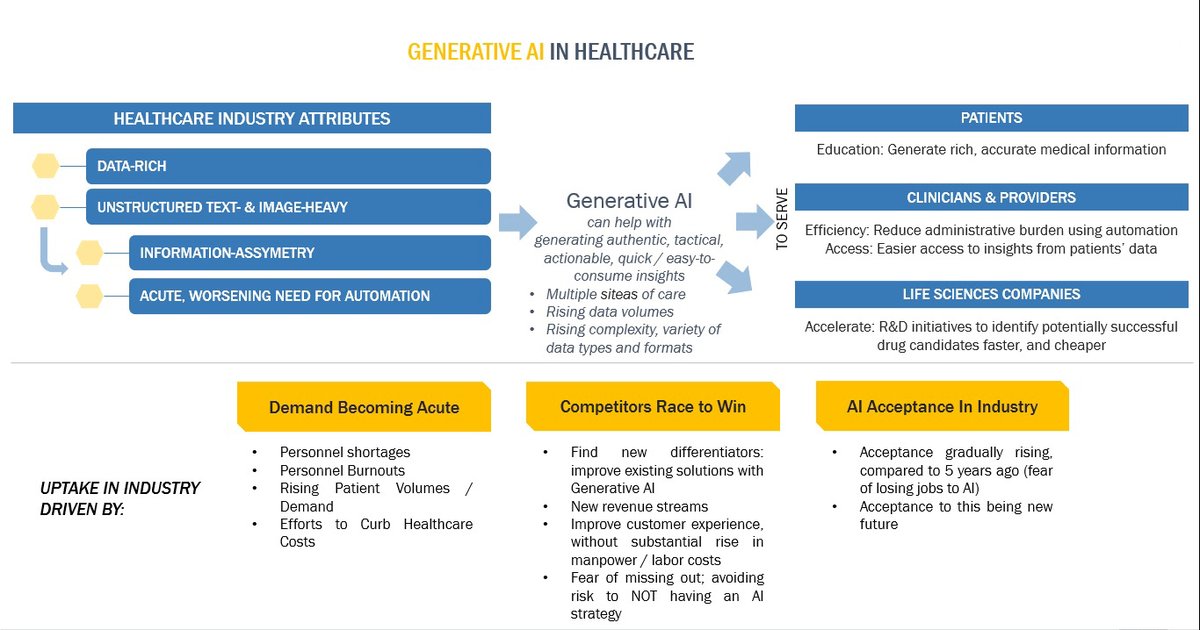
Healthcare: Accelerating Discovery, Enhancing Care
The implications for healthcare are profound, from drug development to patient care.
- Drug Discovery: Generate novel molecular structures and predict their properties, significantly accelerating the early stages of drug development.
- Medical Imaging: Enhance image quality, analyze scans for anomalies, and generate synthetic medical data for training AI models while protecting patient privacy.
- Personalized Medicine: While treatment plans require human oversight, AI can generate initial drafts of personalized treatment pathways based on patient data.
- Regulatory Documentation: Novo Nordisk demonstrated a remarkable 94% headcount reduction and 92% cost saving by using GenAI to draft clinical reports, cutting drafting time from weeks to minutes. This highlights the power of automation in highly regulated fields.
- Symptom Assessment Chatbots: Offer initial guidance for common symptoms, directing patients to appropriate care levels (though human doctors remain critical for diagnosis and empathy).
Finance: Smarter Decisions, Stronger Defenses
Financial institutions are leveraging GenAI for everything from risk management to fraud detection.
- Algorithmic Trading Strategies: Generate and test new trading strategies based on market data.
- Automated Financial Reports: Quickly draft quarterly reports, investment summaries, and other crucial financial documentation.
- Enhanced Fraud Detection: Stripe uses GPT-4 to flag suspicious accounts, demonstrating AI's capability to analyze vast datasets for anomalies indicative of fraud.
- Risk Management: Generate scenarios for value-at-risk (VaR) and economic modeling, helping institutions understand and mitigate potential financial downturns.
- Loan Denial Explanations: Automate the generation of clear, concise explanations for loan denials, improving transparency and compliance.
- AP Automation & Invoice Processing: BBVA employees using customized GPTs reported saving over two hours per week by automating accounts payable tasks and invoice processing.
- Data Privacy: Generate synthetic financial data for analysis and model training, protecting sensitive customer information.
Legal: Automating the Tedious, Empowering the Strategic
The legal sector, often seen as traditional, is embracing GenAI for efficiency and accuracy.
- Contract Generation & Review: Automate the drafting of standard contracts, clauses, and legal documents. Orangetheory used Ironclad AI Assist to reduce project timelines by 50% for contract generation.
- Legal Research: Quickly synthesize information from vast legal databases, identifying relevant precedents and statutes.
- Contract Compliance: Analyze existing contracts for compliance with new regulations or internal policies.
- Legal Chatbots: Provide basic legal guidance and answer common questions, acting as a first point of contact for clients.
- AI Governance & Compliance Automation: Help organizations understand and comply with complex AI regulations, generating necessary documentation and policies.
Education: Tailored Learning, Empowered Educators
GenAI is personalizing the learning experience and streamlining administrative tasks for educators.
- Personalized Lesson Plans & Course Design: Generate custom lesson plans, course syllabi, assessment questions, and even VR simulation scenarios tailored to individual student needs and learning styles.
- Content Generation for Learning: Quickly create quizzes, video scripts for educational content, and supplementary reading materials.
- Tutoring Systems: Platforms like Khan Academy's Khanmigo and Microsoft Copilot in Nigeria are showing significant improvements in student proficiency by providing personalized tutoring and support.
- Synthetic Data for Privacy: Generate non-identifiable student data for research and model training, protecting sensitive information.
- Restoring Old Learning Materials: Digitize and enhance historical educational content, making it accessible for modern learners.
Human Resources: Streamlining Talent Management
From hiring to employee support, GenAI is making HR processes more efficient and data-driven.
- Job Description Generation: Create compelling and accurate job descriptions quickly, attracting the right talent.
- Interview Question Generation: Develop tailored interview questions based on specific roles and desired competencies.
- Onboarding Materials: Automate the creation of personalized onboarding guides and welcome kits for new employees.
- Employee Support Chatbots: Provide instant answers to common HR queries (e.g., benefits, policies), freeing up HR agents. IBM HR agents use "skill-flows" to enhance their support capabilities.
- Workplace Productivity: Microsoft 365 Copilot, for example, has reduced email time by 25% for many users, directly contributing to increased overall workplace productivity.
The Deeper Dive: Specialized Use Cases and Real-World Impact
While the categories above cover broad applications, GenAI’s single-step power extends into highly specialized niches.
- Research & Development: Scientists and researchers can use GenAI to generate novel hypotheses, draft research papers by synthesizing vast amounts of information, and rapidly create product development prototypes and simulations. Studies show AI assistance can make R&D teams 12-16% faster. To truly grasp the underlying mechanisms that enable such rapid content generation, you might Explore mean flows generative modeling, which details some of the advanced techniques behind these capabilities.
- Entertainment & Game Development: Beyond VFX (Netflix's "El Eternauta" used GenAI for cost savings), AI can generate game content, storylines, character designs, and procedural landscapes. This accelerates development cycles and offers endless creative possibilities.
- Real Estate: Generate captivating property descriptions and create virtual tours from basic property data, enhancing listings and buyer engagement.
- Transportation & Logistics: Optimize routes for logistics and transportation, generate models for autonomous vehicle simulation and training, improving efficiency and safety.
- Retail: Offer personalized product recommendations, assist in product and display design, automate retail content generation, and optimize inventory management and supply chains. FLO, for instance, increased net profit by 4.7% with AI forecasting. Virtual shopping assistants powered by GenAI offer a personalized shopping experience.
- Insurance: Automate policy documentation (Lemonade Insurance uses AI "Maya" for instant policy generation), refine risk assessment and premium calculation, improve fraud detection, streamline claims processing, and generate personalized policies.
- Manufacturing: Supports predictive maintenance (BlueScope uses AI for early equipment failure detection), enhances quality control through anomaly detection, and optimizes production planning and inventory management.
- Sales: Create personalized sales videos, provide sales coaching based on call transcripts, forecast sales and optimize pipelines, and identify/qualify leads more efficiently.
- Audit: Automate audit reporting (KPMG partnered with MindBridge for AI-driven anomaly detection), analyze documents for discrepancies, provide real-time risk monitoring, and assist in pattern recognition.
- Productivity and Automation: Beyond specific industries, AI workflow agents like Claude Max can perform end-to-end tasks across applications, from high-precision Excel tasks to document and presentation generation. This represents a significant leap in general workforce productivity.
- Social Media: Support content moderation by filtering inappropriate content and automating social media management tasks like post creation and scheduling.
Beyond the Hype: Benefits You Can Expect
The adoption of single-step generative AI isn't just about novelty; it delivers tangible, strategic advantages:
- Enhanced Customer Experience: By enabling personalized interactions and providing instant, data-driven insights, GenAI makes every customer touchpoint more relevant and satisfying.
- Strengthened Cybersecurity: GenAI can analyze vast datasets of network traffic and user behavior to identify and mitigate threats faster than human analysts, making systems more resilient.
- Automated Content Generation at Scale: From marketing copy to internal reports, businesses can produce a high volume of diverse content efficiently, freeing up human talent for more strategic work.
- Improved Product Designs and Innovation: GenAI fosters creativity by generating innovative design suggestions and prototypes, allowing companies to respond to evolving market preferences with agility.
- Significant Cost Savings: Automating repetitive tasks across various departments—from customer service to legal—translates into substantial operational cost reductions.
- Increased Productivity: Empowering employees with AI tools to handle routine tasks allows them to focus on complex problem-solving and creative endeavors, boosting overall team output.
Navigating the Landscape: Challenges and Considerations
While the benefits are clear, responsible adoption of single-step GenAI requires a keen awareness of its limitations and potential pitfalls.
- Accuracy and Hallucinations: Generative AI models can sometimes produce incorrect, nonsensical, or entirely fabricated information ("hallucinations"). This necessitates human verification for all critical outputs, especially in fields like healthcare, finance, and legal. Trust, but verify, is the golden rule.
- Lack of Transparency (The "Black Box" Problem): Understanding why a GenAI model produced a particular output can be challenging. Their internal workings are often complex and not fully interpretable, making it difficult to debug errors or ensure ethical decision-making.
- Cybersecurity Risks and Fraud: The same powerful AI techniques can be leveraged by malicious actors for sophisticated phishing campaigns, deepfake scams, and advanced cyberattacks. Robust mitigation strategies are essential.
- Bias Amplification: GenAI models learn from the data they're trained on. If this data contains historical biases (e.g., racial, gender, socio-economic), the AI will perpetuate and even amplify these biases in its outputs, leading to unfair or discriminatory results. Policies and controls for bias detection and management are critical.
- Ethical Minefields: Concerns abound regarding deepfakes and consent violations, intellectual property theft (especially for art and creative content), and the potential for widespread job displacement in creative and knowledge-worker industries. Navigating these ethical considerations requires careful thought and robust governance frameworks.
Making Single-Step GenAI Work For You: Best Practices for Adoption
Integrating single-step GenAI effectively isn't just about deploying technology; it's about strategic planning, human empowerment, and ethical vigilance.
- Human Oversight is Non-Negotiable: Always position AI as a co-pilot, not an autonomous agent. Human review, editing, and fact-checking are crucial for maintaining accuracy, ethical standards, and brand voice. No single-step output should go live without a human eye on it.
- Strategic Integration, Not Replacement: Identify tasks where AI can augment human capabilities, automate repetitive work, or accelerate ideation. Focus on using AI to make existing workflows more efficient, rather than attempting to replace entire human roles outright. Think about how it supports a legal professional in drafting contracts, not replacing the lawyer themselves.
- Data Governance and Ethical AI Frameworks: Establish clear guidelines for data usage, privacy, and bias mitigation. Develop an ethical AI framework that addresses issues like transparency, accountability, and the responsible use of generated content. This includes clarifying intellectual property rights when using generated assets.
- Continuous Learning and Adaptation: The GenAI landscape is evolving at a breakneck pace. Stay informed about new models, capabilities, and best practices. Implement feedback loops to improve your AI's performance and ensure it aligns with your evolving business needs.
- Start Small, Scale Smart: Begin with pilot projects in low-risk areas to understand the technology's capabilities and limitations within your specific context. Learn from these initial implementations before scaling to broader applications. This iterative approach helps build confidence and refine your strategy.
- Train Your Teams: Equip your employees with the skills to effectively prompt, utilize, and critically evaluate AI-generated content. The human element remains paramount in making these tools truly powerful.
The Road Ahead: Empowering Your Future with Generative AI
The immediate, impactful results delivered by single-step generative AI are undeniably transforming how we work, create, and interact. From writing a marketing campaign to designing a new product, or even streamlining complex financial analysis, these tools offer unprecedented speed, scale, and personalization.
While the "magic" is real, successful implementation hinges on a strategic blend of technological adoption, robust human oversight, and a deep commitment to ethical considerations. The future isn't about AI replacing humans, but about humans empowered by AI, unlocking new levels of creativity, efficiency, and problem-solving. By understanding its applications, embracing its advantages, and intelligently navigating its challenges, you can harness single-step generative AI to forge a more innovative, productive, and responsive future for your organization and beyond.